
Factories, manufacturing plants, warehouses and large commercial facilities in Pakistan use substantial electricity to run machinery, production lines, cooling systems and essential operations. An industrial solar system can help a business generate part of its electricity on-site, reduce daytime grid consumption and make energy costs easier to manage. The right solution depends on the facility’s load profile, operating hours, site conditions and utility arrangement—not simply the number of panels installed.
What Is an Industrial Solar System?
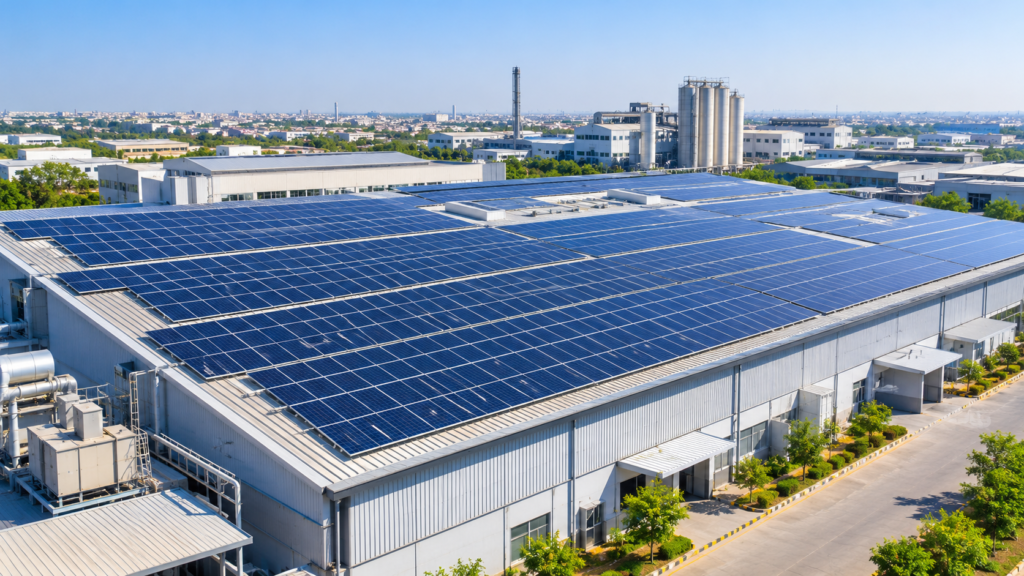
An industrial solar system is a solar power installation designed around the electrical requirements of factories, manufacturing units, warehouses and other high-consumption facilities. It typically combines solar modules, commercial or industrial inverters, mounting structures, electrical protection, monitoring and grid-interconnection equipment. Battery storage can also be included when backup or energy-shifting requirements justify the additional investment.
Unlike a small standard installation, an industrial project needs careful assessment of three-phase loads, maximum demand, transformer and switchgear capacity, cable routes, roof or ground conditions, safety requirements and future expansion plans.
Why Are Businesses in Pakistan Considering Industrial Solar?
For many businesses, electricity is a significant operating expense. Generating solar electricity on-site can offset some of the energy a facility would otherwise draw from the grid, especially when production and other major loads operate during daylight hours.
- Manage electricity expenses: Solar generation can reduce grid imports while the system is producing and the facility is consuming power.
- Improve energy planning: Monitoring helps businesses review generation, consumption, grid imports and system performance.
- Support sustainability goals: On-site renewable generation can contribute to a business’s environmental objectives.
- Plan for backup where needed: A suitably designed hybrid system with battery storage can support selected critical loads during outages.
Actual savings depend on the site’s load profile, applicable electricity tariff, solar generation, self-consumption, export arrangements, system cost and ongoing operating expenses. A project-specific feasibility assessment is more reliable than a generic savings promise.
Choosing the Right Industrial Solar System Capacity
Industrial solar capacity should be selected after reviewing electricity bills, interval or load data where available, maximum demand, operating shifts, available installation area and the facility’s expansion plans. The capacities below are broad project examples, not fixed recommendations for a particular type of factory.
| Indicative solar capacity | Possible application |
|---|---|
| 50–100 kW | Smaller factories and commercial facilities |
| 100–250 kW | Medium-sized industrial units |
| 250–500 kW | Large factories and warehouses |
| 500 kW–1 MW | High-consumption industrial facilities |
| 1 MW and above | Large manufacturing sites and industrial complexes |
A facility with high daytime consumption may be suited to a grid-connected solar system. A site that needs backup for selected machinery or essential processes may also consider a hybrid configuration. The final design must be checked against electrical infrastructure, inverter limits and applicable interconnection requirements.
Industrial Solar Inverters: What Should Be Considered?
The inverter converts the DC electricity generated by solar panels into AC electricity for the facility’s electrical system. In larger projects, inverter selection and configuration should account for solar array capacity, three-phase supply, voltage and current limits, grid compatibility, protection, monitoring and any battery integration requirements.
High-capacity inverter solutions, including 250 kW and 500 kW-class equipment, may be relevant to larger projects, but the correct configuration depends on the manufacturer’s specifications and the site’s electrical design. Multiple inverters may be used where the project design calls for them.
Industrial Battery Storage: When Does BESS Make Sense?
A Battery Energy Storage System (BESS) stores electricity for use later. In an industrial hybrid installation, battery storage may be considered where a business needs backup for selected critical loads, wants to shift some energy use to another period, or has a specific energy-management requirement.
- Backup for critical loads: A correctly designed battery and inverter system can supply designated loads during a grid outage, within its power and energy limits.
- Energy shifting: Stored energy may be used later, subject to battery capacity, efficiency and system controls.
- Solar utilization: Storage can capture some surplus solar generation that might otherwise be exported or curtailed, depending on system settings and grid arrangements.
- Load management: Some projects can use storage to support defined demand-management strategies after a technical and financial review.
Battery storage is not essential for every industrial solar project. Its additional capital cost, usable energy, discharge power, round-trip efficiency, warranty, expected cycling and replacement considerations should be assessed against the value it provides. For a deeper look at this technology, read our guide to industrial battery storage and BESS in Pakistan.
Grid-Tied vs Hybrid Industrial Solar Systems
Grid-Tied Industrial Solar
A grid-tied system operates alongside the utility supply. Solar electricity is used by the facility’s loads when available, while the grid supplies any additional electricity required. Export of surplus energy depends on the applicable approvals, metering arrangement and current regulations. A conventional grid-tied inverter generally shuts down during a grid outage for safety unless a specifically engineered backup arrangement is provided.
Hybrid Industrial Solar
A hybrid system combines solar generation, battery storage and the grid. With compatible equipment and correctly configured backup circuits, it can supply selected loads during an outage. The battery and inverter must be sized for the required power, backup duration and load characteristics; a hybrid system does not automatically mean that the entire factory can operate independently of the grid.
To understand the differences in more detail, see our guide to hybrid vs on-grid solar systems in Pakistan.
How Much Does an Industrial Solar System Cost in Pakistan?
There is no single price for every industrial solar project. The total investment depends on system capacity, module and inverter specifications, mounting structure, electrical protection, cabling, installation conditions, monitoring, grid-interconnection work and engineering requirements. A hybrid project with battery storage will generally have additional equipment and costs compared with a similar grid-tied project.
For a meaningful quotation, a business should provide recent electricity bills, sanctioned load or maximum demand information, operating hours, site location, available roof or ground area and any backup requirements. This allows the proposed design and scope to be matched to the actual facility.
How to Estimate the ROI of an Industrial Solar Project
A useful starting point is to estimate how much solar electricity the facility will consume directly. The value of each unit depends on the electricity cost it actually offsets and the applicable billing and export arrangements.
Estimated annual gross bill savings = Solar electricity used on-site × Applicable cost per unit avoided
For illustration, if a system generates 500,000 units in a year and the facility uses 80% of that generation directly, 400,000 units are consumed on-site. The financial value of those units should be calculated using the relevant tariff components that are genuinely avoided. Any exported electricity should be valued separately under the applicable arrangement.
Simple payback period = Total project investment ÷ Annual net financial benefit
A proper financial model should also consider maintenance, cleaning, inverter and battery replacement assumptions, system degradation, financing costs, taxes, operating schedules and changes to tariffs or export rules. Payback estimates should be based on the customer’s actual data rather than guaranteed in advance.
Industrial Solar Projects in Karachi and Across Pakistan
Karachi’s factories, warehouses and commercial facilities have varied electricity requirements and operating schedules. A daytime manufacturing unit, a cold-storage facility and a multi-shift factory may each need a different solar and storage configuration. Site assessment should include roof or ground conditions, shading, structural suitability, electrical infrastructure, safety access and the facility’s load profile.
Universal Solar also provides industrial solar solutions and commercial solar solutions. You can also review an example of our 240 kW solar project in Karachi.
Why Choose Universal Solar for an Industrial Solar Project?
Industrial solar requires coordinated planning across generation equipment, electrical infrastructure, protection, monitoring and the customer’s operating needs. Universal Solar works with businesses to assess their requirements and consider suitable on-grid or hybrid configurations for factories, warehouses and commercial facilities in Karachi and across Pakistan.
Whether you are considering a 100 kW installation, a 500 kW industrial solar system or a larger project, begin with your electricity data and site requirements. Contact Universal Solar to discuss a project assessment and quotation.
Frequently Asked Questions
What size solar system does a factory need?
The required capacity depends on electricity consumption, maximum demand, operating hours, available installation area and future plans. A load assessment should be completed before selecting a system size.
Is industrial solar worth investing in Pakistan?
It can be attractive for facilities that use a substantial share of solar generation on-site. The business case depends on project cost, solar yield, electricity tariffs, operating schedule, export arrangements and financing.
Can an industrial solar system operate during load shedding?
A conventional grid-tied inverter generally shuts down during a grid outage. A suitably designed hybrid system with battery storage and backup circuits can supply designated loads within its rated limits.
Is battery storage necessary for industrial solar?
No. Battery storage is optional. It should be considered when backup, energy shifting or another defined operating requirement justifies its cost.
Can a 500 kW solar system run an entire factory?
That depends on the factory’s demand and the timing of its electricity use. Solar output varies with sunlight, and the grid or an appropriately designed storage system may still be needed to meet loads when solar generation is insufficient.
How can a business request an industrial solar quotation?
Share recent electricity bills, sanctioned load or maximum demand, operating hours, site location, available installation area and any backup requirements with Universal Solar. These details help establish a suitable system configuration and project estimate.
Conclusion
Industrial solar can help businesses in Pakistan manage grid electricity consumption and plan for long-term energy needs. The best solution is determined by the facility’s actual load profile, electrical infrastructure, operating schedule and financial objectives. Whether the project calls for a grid-tied installation, a hybrid system or battery energy storage, careful engineering and realistic financial analysis are essential.
Planning an industrial solar project in Pakistan? Contact Universal Solar to discuss a solution designed around your business requirements.