
Factories and industrial facilities in Pakistan are increasingly looking beyond solar panels alone. An existing on-grid solar plant can reduce daytime electricity purchases, but it may not store surplus generation for use later in the day. Battery Energy Storage Systems (BESS) can help businesses manage this gap—when the site’s load profile, electrical infrastructure and project economics support it.
For some facilities, adding batteries does not mean replacing the entire solar installation. A carefully engineered retrofit may integrate a battery system with an existing solar plant using a suitable Power Conversion System (PCS), Energy Management System (EMS), protection equipment and control strategy. The right design depends on the existing inverters, grid connection, loads and the operating objectives of the facility.
Why are industries considering battery storage?
Industrial electricity demand does not always match solar generation. A factory may have strong solar production around midday but continue operating into the evening, experience short-duration demand peaks, or need a more controlled supply for selected critical loads. Depending on the tariff structure and operating pattern, a properly sized BESS may help a facility:
- Store some surplus solar energy for later use instead of relying only on immediate consumption or export.
- Reduce grid electricity drawn during selected high-cost periods, where the tariff and control strategy make this economical.
- Manage short-duration demand peaks, if the PCS power rating and battery operating limits are designed for that duty.
- Provide backup support to designated critical loads when the system is specifically designed for backup or islanded operation.
- Improve visibility and control of energy flows across solar, battery, grid and facility loads.
These outcomes are not automatic. Actual performance depends on battery capacity, PCS power, round-trip efficiency, operating limits, tariff rules, solar production, load profile and the way the system is controlled.
What is an industrial BESS?
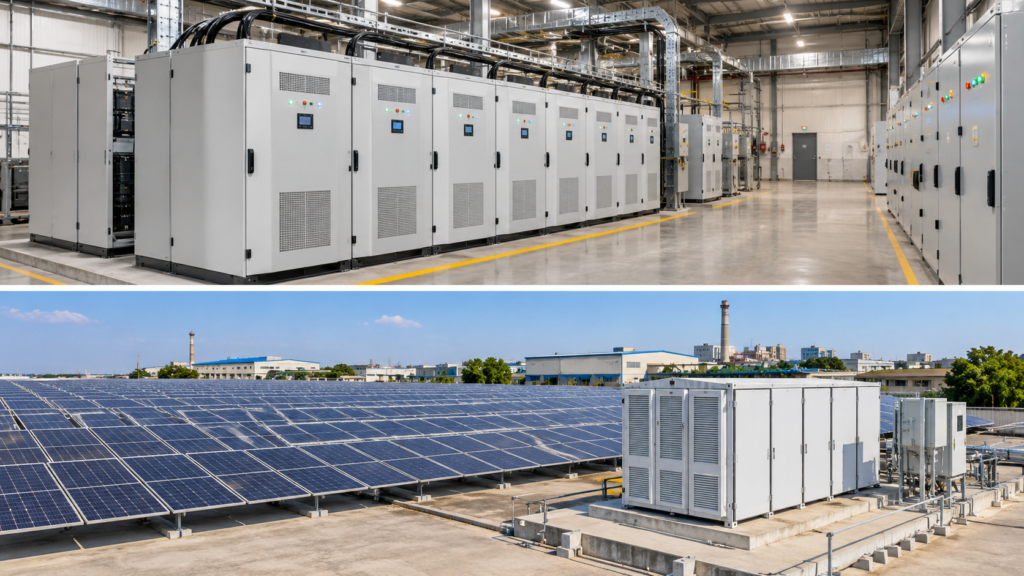
A Battery Energy Storage System (BESS) is more than a battery cabinet. It is an integrated system that stores electrical energy and delivers it when required. A typical industrial BESS may include:
- Battery modules and racks: store energy, commonly using lithium-ion technology selected for the project’s duty, safety requirements and operating environment.
- Battery Management System (BMS): monitors cell and pack conditions and manages permitted charging and discharging limits.
- Power Conversion System (PCS): converts power between the battery’s DC side and the facility’s AC electrical system.
- Energy Management System (EMS): coordinates when the battery charges or discharges according to operating priorities and system conditions.
- Electrical balance of system: switchgear, breakers, cabling, isolation, metering, protection, earthing and other equipment required for safe integration.
- Thermal management and fire protection: systems selected in line with the battery technology, installation environment, applicable codes and manufacturer requirements.
What does the PCS do in a battery storage project?
PCS stands for Power Conversion System. It is the bidirectional power converter that connects the battery’s DC electrical system to the facility’s AC system. During charging, it converts AC power into the form required by the battery. During discharge, it converts battery DC power into AC power for the connected loads or electrical bus.
The PCS is not simply selected to match the battery’s kWh capacity. Its kW rating determines how much power can be charged or delivered at a given moment. The selection must account for the facility’s load profile, peak demand, desired discharge duration, battery voltage and current limits, grid arrangement, power quality requirements and whether grid-connected or backup operation is required.
What is the role of the EMS?
The Energy Management System coordinates the operation of the solar plant, BESS, grid connection and facility loads. Depending on the equipment and control functions available, the EMS can follow strategies such as charging from available solar surplus, limiting battery charging from the grid, discharging during selected periods, maintaining a reserve state of charge, or responding to a demand limit.
For an industrial project, the control strategy should be based on actual interval load data and the facility’s operating priorities—not on battery capacity alone. Communication compatibility between the EMS, PCS, BMS, meters and existing solar inverters must also be confirmed before implementation.
Can an existing on-grid solar system be converted to include batteries?
In many cases, an existing solar plant can be assessed for battery integration, but not every installation is suitable for a straightforward conversion. The existing inverter architecture, AC and DC ratings, protection arrangement, transformer and switchgear capacity, grid connection, control interfaces and available installation space all matter.
One common approach is an AC-coupled BESS. In this arrangement, the existing solar inverters continue converting PV power to AC, while a separate bidirectional PCS connects the battery to the facility’s AC bus. This can be useful for retrofits because it may allow the existing PV inverters to remain in service, subject to compatibility and engineering checks.
A DC-coupled arrangement connects the battery on the DC side of a compatible power conversion architecture. It may offer benefits in some new-build or specifically designed systems, but retrofitting an existing plant this way can involve more extensive changes. The preferred arrangement must be determined from the equipment design and project objectives.
Importantly, adding an AC-coupled battery does not automatically mean the facility will have backup power during a grid outage. Backup or islanded operation may require a grid-forming PCS, appropriate isolation and transfer equipment, black-start capability, protection coordination and a defined critical-load arrangement. These functions must be specified and tested as part of the design.
How is an industrial solar-to-battery retrofit assessed?
A practical feasibility study should begin with the facility’s electricity data and existing single-line diagram (SLD). The assessment typically covers:
- Load profile: interval demand, operating shifts, peak demand, evening consumption and critical loads.
- Existing solar plant: PV capacity, inverter models and ratings, generation history, export behaviour and any known clipping or curtailment.
- Electrical infrastructure: AC bus, transformer, switchgear, protection, metering, cable routes, earthing and available space.
- Battery requirements: usable energy in kWh, charge and discharge power in kW, operating window, reserve state of charge and required duration.
- PCS and EMS compatibility: communication protocols, control capabilities, grid-following or grid-forming functions and integration with existing equipment.
- Safety and compliance: battery location, ventilation or thermal management, fire detection and suppression strategy, emergency isolation, access and applicable local requirements.
- Financial assessment: installed cost, tariff structure, demand charges where applicable, energy savings, efficiency losses, battery degradation, maintenance and expected replacement costs.
Battery capacity (kWh) and PCS power (kW): why both matter
Battery energy capacity is measured in kilowatt-hours (kWh), while PCS power is measured in kilowatts (kW). These are different specifications. The kWh rating indicates how much energy can be stored; the kW rating indicates how quickly energy can be delivered or absorbed.
For example, a battery may have enough stored energy for several hours at a modest load but still be unable to support a large motor or a high-power demand peak if the PCS is undersized. Conversely, a high-power PCS paired with a small battery may deliver strong output only for a short period. Sizing should therefore be based on the facility’s measured demand and intended operating duration.
Will industrial battery storage reduce electricity costs?
It can, but savings must be calculated for each site. The business case depends on the difference between the cost of electricity avoided and the effective cost of stored energy after conversion losses, battery degradation and operating expenses. It also depends on whether the tariff rewards peak reduction or time-shifting, how much solar surplus is available, and how consistently the battery can be used.
A credible proposal should compare the expected operating strategy with actual bills and interval data. It should not promise a fixed percentage of savings or a guaranteed payback period without a site-specific analysis.
Which industrial facilities may benefit from BESS?
Battery storage may be worth assessing for factories, warehouses, food processing facilities, cold storage, textile units, packaging plants, commercial buildings and other sites with substantial electricity use beyond solar production hours. The strongest candidates are identified by their load profile, tariff structure, reliability requirements and the technical feasibility of integrating storage—not by industry name alone.
Why work with Universal Solar?
Universal Solar provides solar energy solutions for residential, commercial and industrial applications in Pakistan. For businesses considering battery storage alongside an existing solar installation, the first step is to review the current plant, understand the facility’s electricity demand and establish whether an AC-coupled or DC-coupled solution is technically and financially appropriate.
You can also read our guide to industrial solar installation and commercial solar solutions to learn more about solar applications for business and industry.
Frequently asked questions about industrial BESS and PCS
Can batteries be added to an existing on-grid solar plant?
Often they can, but compatibility must be assessed. The existing inverter arrangement, electrical infrastructure, protection, controls, available space and operating requirements determine whether a retrofit is feasible.
Does an industrial BESS need a separate PCS?
Many AC-coupled retrofits use a separate bidirectional PCS. Other architectures may integrate conversion functions differently. The equipment arrangement depends on the battery and inverter design selected for the project.
What is the difference between PCS and EMS?
The PCS converts electrical power between the battery and AC system. The EMS decides and coordinates how the system should operate, using site data, operating priorities and available control functions.
Will a battery automatically provide backup during a grid failure?
No. Backup operation requires compatible grid-forming equipment, isolation and transfer arrangements, suitable protection and a defined critical-load design. A grid-connected battery system may shut down during an outage if it has not been designed for islanded operation.
How do I know what battery size my factory needs?
Battery sizing requires interval load data, solar generation data, the facility’s operating schedule, tariff details and the intended use of storage. Both energy capacity (kWh) and PCS power (kW) must be evaluated.
Request an industrial battery storage assessment
If your factory or commercial facility already has an on-grid solar system and you are considering adding battery storage, speak with Universal Solar about an initial technical assessment. Share your recent electricity bills, solar inverter details, system capacity and—if available—interval load data so the proposed solution can be evaluated properly.
Call or WhatsApp: +92 348 6824073
Website: universalsolar.com.pk