
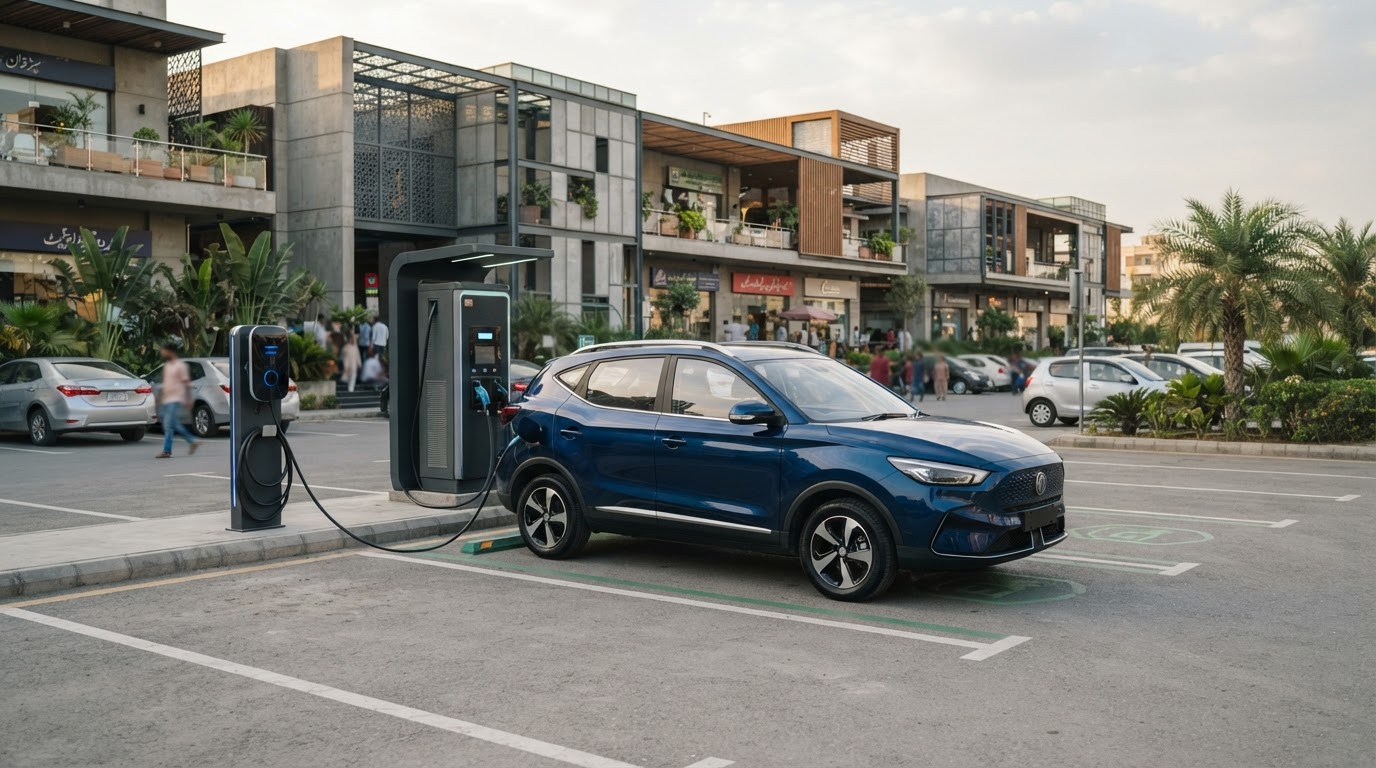
Electric vehicle charging is becoming a potential new service for businesses in Pakistan. Shopping centres, hotels, offices, fuel stations, parking operators and fleet facilities may be able to serve EV drivers by adding charging points. But opening a charging station is more than buying a charger: the site, electrical supply, customer demand, operating model and ongoing maintenance all affect whether a project is practical.
This guide explains the main decisions involved in planning a commercial EV charging station in Pakistan. It is intended for property owners and businesses evaluating a project—not as a promise of fixed investment costs or guaranteed returns. Every site needs its own technical and commercial assessment.
1. Who can consider an EV charging station business?
Commercial EV charging may be worth evaluating for businesses that already have parking, customer traffic or vehicles that remain on-site for predictable periods. Potential locations include:
- Shopping malls and retail centres
- Hotels, restaurants and destination venues
- Office buildings and business parks
- Fuel stations and roadside service locations
- Public and private parking facilities
- Housing developments and mixed-use projects
- Taxi, delivery and corporate fleet depots
The best location is not automatically the busiest road. It is a site where drivers can access the chargers safely, remain parked for an appropriate period and find the service useful.
2. Choose the right charging model: AC or DC
Charger type should match the way customers use the site. An expensive high-power charger may be unsuitable where vehicles normally park for several hours, while a lower-power charger may not meet the needs of a short-stop location.
AC destination charging
AC chargers are commonly considered for hotels, offices, restaurants, shopping destinations and parking facilities where vehicles can stay connected for longer. The vehicle’s onboard charger, the EVSE rating and the available electrical supply determine the actual charging rate.
DC fast charging
DC fast chargers are intended for sites where shorter charging stops are important, such as selected public locations, travel corridors and fleet operations. They generally require more substantial electrical infrastructure, careful load planning and a higher level of project investment.
Before selecting equipment, confirm the connector standards and charging capability of the vehicles expected to use the station. Do not assume every vehicle accepts the same connector or maximum charging power.
3. Assess the location before buying equipment
A site assessment helps determine whether the proposed location can support a safe, accessible and useful charging service. Review the following points:
- Access and visibility: Can drivers find and enter the site easily?
- Parking layout: Are bays, turning space and charger positions practical?
- Vehicle dwell time: How long are customers likely to stay?
- Safety: Can cables, equipment and vehicles be arranged without creating trip or traffic hazards?
- Weather exposure: Is the equipment suitable for the installation environment?
- Expansion: Is there room to add chargers if demand grows?
- Connectivity: Will communications, monitoring and any payment system work reliably?
4. Check electrical capacity and grid connection
Electrical feasibility is one of the most important parts of a commercial EV charging project. The available supply must be checked against the proposed charger capacity and the site’s other electrical loads.
A qualified electrical professional should review the incoming supply, sanctioned or available load, transformer and distribution capacity where applicable, switchgear, cable routes, earthing, protection and utility requirements. A project may need a supply enhancement or other electrical work; this cannot be determined from the charger rating alone.
For multiple chargers, load management may help coordinate charging demand within the site’s available capacity, provided the selected equipment and control system support it. The design should also account for future expansion rather than relying on an optimistic estimate of spare capacity.
5. Understand the main setup cost components
There is no single reliable installation price for every EV charging station in Pakistan. The total project cost depends on charger type and quantity, site conditions, electrical capacity and the level of service being offered. A project budget should consider:
- AC or DC charging equipment and accessories
- Electrical panels, switchgear, cabling and protection
- Transformer, connection or supply upgrades if required
- Foundations, mounting, trenching and other civil works
- Parking-bay marking, signage, lighting and barriers
- Communications, charger management and payment systems
- Installation, testing, commissioning and staff training
- Maintenance, support, insurance and operating expenses
When comparing quotations, check whether each supplier has included the same scope. An equipment-only price is not comparable with a complete installed project that includes electrical and civil works.
6. Plan the business model and expected utilisation
Before investing, decide how the charging service will operate. A business might offer charging as a paid service, provide it as an amenity to attract customers, support its own fleet or combine more than one approach. The right model depends on the location and customer base.
Build a realistic forecast using assumptions that can be tested:
- Expected charging sessions per day and average energy delivered per session
- Likely busy and quiet periods
- Electricity purchase cost and any applicable demand or connection charges
- Customer pricing and payment costs
- Equipment uptime, maintenance and support costs
- Staffing, rent or site-sharing arrangements
- Competition and other charging options nearby
Do not base a return-on-investment estimate on charger capacity multiplied by all hours in a day. Actual utilisation is limited by customer demand, vehicle dwell time, charger availability, energy supply and operating conditions. Prepare conservative, expected and higher-demand scenarios before making a decision.
7. Can solar power support a commercial EV charging station?
Solar PV can contribute to EV charging when generation is available and the electrical system is designed to manage the combined loads. For a business with suitable roof or parking-canopy space, solar may be evaluated as part of the site’s energy plan.
A solar-plus-EV assessment should consider PV capacity, inverter output, the charging schedule, existing building demand, grid import and export arrangements, and any battery storage. Battery storage may provide additional flexibility, but it should not be assumed to support high-power DC charging unless the inverter, battery and electrical design are specifically sized for that duty.
Solar integration is therefore a site-specific design decision, not an automatic reduction in charging costs. Compare the expected solar energy available during charging hours with the station’s actual load profile.
8. Operations, payments and customer experience
A charging station needs a plan for day-to-day operation after installation. Consider how customers will find the location, start a session, pay, receive help and report a problem. Depending on the equipment and business model, useful features may include remote monitoring, session records, access control, payment integration and fault alerts.
Also plan for routine inspections, preventive maintenance, software updates where applicable, customer support and a process for taking a charger out of service safely when required. Clear pricing and visible instructions help reduce confusion for first-time users.
9. A practical checklist before committing to a project
- Define whether the site will serve the public, customers, employees or a private fleet.
- Estimate likely demand and vehicle dwell time.
- Confirm the vehicle types, connectors and charging speeds to be supported.
- Complete a site survey and electrical feasibility assessment.
- Check utility, building, safety and other applicable approval requirements.
- Compare complete project quotations with matching scopes.
- Prepare conservative utilisation and operating-cost scenarios.
- Decide on maintenance, payment, monitoring and customer support.
- Plan a phased installation or future expansion where appropriate.
10. Frequently asked questions
Is an EV charging station business possible in Pakistan?
It may be possible for suitable locations and business models, but feasibility depends on local EV demand, site access, electricity availability, equipment costs, operating expenses and applicable requirements. A site-specific assessment is essential before investment.
Should a commercial site install AC or DC chargers?
AC charging may suit destinations where vehicles remain parked for longer periods. DC fast charging may suit shorter-stop locations with sufficient electrical infrastructure. The decision should follow an assessment of customer dwell time, demand and available power.
How much does it cost to set up an EV charging station in Pakistan?
Costs vary with charger type and quantity, electrical upgrades, cabling, civil works, software and site conditions. A meaningful estimate requires a defined project scope and site assessment.
Can a commercial EV charging station run on solar power?
Solar generation can contribute to charging when the PV, inverter, charger and site electrical design are compatible. The available solar energy and charging demand need to be assessed together.
Can I start with a few chargers and expand later?
A phased approach may be practical if the initial electrical design, site layout and equipment platform allow for future expansion. The first phase should still be designed with the likely later load in mind.
Plan a Commercial EV Charging Project with Universal Solar
Considering EV charging for a hotel, shopping centre, office, parking facility, fleet or commercial property? Universal Solar can discuss the initial requirements for home, workplace and commercial EV charging projects, including the potential integration of solar energy.
Explore our EV charger installation and charging solutions page for an overview of our services. For background on charger types, vehicle compatibility and home charging, read our EV charging guide for Pakistan.
Discuss your proposed site with Universal Solar: Send your project details on WhatsApp. Include the location, property type, intended users and any available information about the electrical supply.
Important: Charger specifications, vehicle compatibility, electricity tariffs and applicable approval requirements can change. Confirm current details with the relevant equipment supplier, utility and qualified professionals before proceeding.