
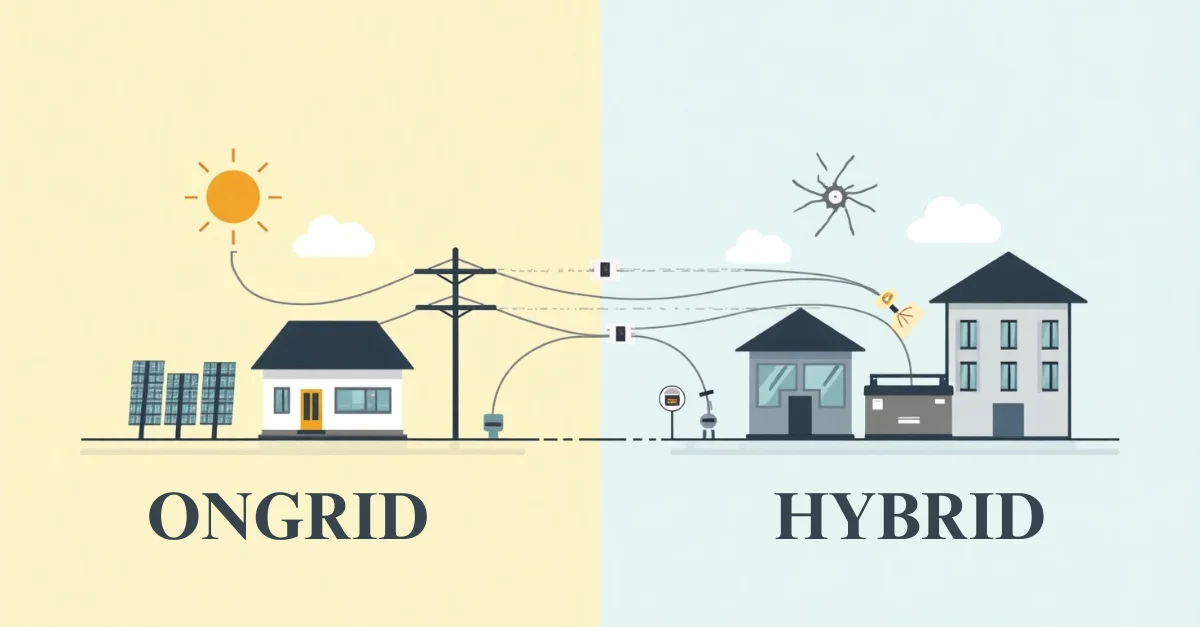
Pakistan’s solar market has entered a new phase. With the NEPRA Prosumer Regulations 2026 replacing the previous net-metering framework for new applicants with net billing, the financial value of every solar unit matters more than ever. For homeowners, offices, factories and commercial buildings, the key question is no longer simply how much electricity a solar system generates. It is how much of that electricity can be used on-site, stored for later or exported to the grid.
So, is a hybrid solar system now a better investment than an on-grid solar system in Pakistan? The answer depends on your consumption pattern, grid reliability, battery cost and whether you already have a valid net-metering agreement. This guide explains the practical and financial differences.
1. What Is an On-Grid Solar System?
An on-grid solar system works in synchronization with the utility grid. Solar panels generate electricity during daylight hours, and the building uses that power first. Surplus electricity can be exported to the grid where the consumer has the required approval and applicable agreement.
Because a standard on-grid system does not include battery storage, its initial installation cost is generally lower than a comparable hybrid system. It can be a practical choice for consumers who use most of their electricity during the day and have a reliable grid supply.
2. What Is a Hybrid Solar System?
A hybrid solar system combines solar panels, a hybrid inverter, battery storage and the utility grid. Solar electricity can power the building directly, charge batteries or be exported where the system and interconnection arrangement permit it. Stored energy can then support loads after sunset or during a grid outage, subject to system design and battery state of charge. If you are considering this solution, explore our hybrid solar systems in Karachi.
- Stores surplus daytime solar energy for later use.
- Can provide backup during grid outages when configured with backup circuits.
- Can reduce the amount of electricity purchased from the grid during evening and peak-use periods.
- Offers greater control over when solar energy is consumed, stored or exported.
3. Pakistan’s 2026 Solar Policy: Net Metering vs Net Billing
Under the NEPRA Prosumer Regulations 2026, which took effect on 9 February 2026, new prosumer connections are generally billed under a net-billing arrangement. Electricity imported from the distribution company is billed at the consumer’s applicable tariff, while electricity exported to the grid is credited at the applicable National Average Energy Purchase Price (NAEPP). The export credit is not the same as the retail price paid for imported electricity.
For 2026, the reported NAEPP export credit is approximately Rs8.13 per unit. This rate may be revised by the regulator, so consumers should confirm the current applicable rate and their utility’s billing treatment before making an investment decision. The actual import rate varies by consumer category, tariff slab, taxes, duties and other bill components; there is no single nationwide Rs11 import rate.
Existing customers: NEPRA’s subsequent amendment protects valid agreements executed under the earlier regulations until their expiry, subject to the regulatory conditions. A material modification that increases the facility’s maximum electrical output can affect that protection. Existing system owners should check their own agreement and consult their distribution company before changing system capacity or making a major modification.
In short, the policy makes self-consumption more important for new net-billing customers: using solar electricity on-site can avoid buying an equivalent unit at the applicable retail tariff, while exporting that unit earns the lower export credit.
4. Hybrid vs On-Grid Solar: Quick Comparison
| Feature | On-Grid Solar | Hybrid Solar |
|---|---|---|
| Battery storage | Usually not included | Included when specified |
| Backup during grid outages | Standard grid-tied systems shut down during outages | Can provide backup through configured backup output and batteries |
| Initial investment | Generally lower | Generally higher due to batteries and hybrid equipment |
| Daytime self-consumption | Yes | Yes |
| Store surplus solar for evening use | No, not without separate storage | Yes, within battery and inverter limits |
| Export to grid | Subject to applicable approval and agreement | Possible where permitted and correctly configured |
| Best suited to | High daytime use and reliable grid supply | Evening use, backup needs and higher self-consumption goals |
5. Why Battery Storage Can Improve Solar Economics
When exported electricity receives a lower credit than the price of imported electricity, storing some surplus solar generation can be financially attractive. Instead of exporting all excess power during the day, a hybrid system can charge its battery and use that energy later when the building would otherwise draw electricity from the grid.
For illustration, assume 100 kWh of surplus solar energy is available. If exported at Rs8.13 per unit, it would earn approximately Rs813 in export credit. If the same 100 kWh could instead be stored and later used to avoid buying electricity at an assumed Rs34 per unit, the avoided energy cost would be Rs3,400 before battery losses and costs. The gross difference is Rs2,587.
This is an illustrative comparison, not a guaranteed saving. Battery charging and discharging losses mean that 100 kWh sent into storage will not deliver 100 kWh back to the load. Battery degradation, usable capacity, inverter efficiency, installation cost, financing and the timing of consumption must all be included in a proper payback calculation.
6. Example: How Much Could Self-Consumption Be Worth?
Consider a business that can use 900 kWh of stored solar electricity during evening hours instead of purchasing those units from the grid. If its applicable avoided energy rate is assumed to be Rs34 per kWh, the gross avoided energy cost is Rs30,600 for that month. This figure must be reduced to account for storage losses and the cost of cycling the battery, and it does not include fixed charges or other bill components.
The right way to size a battery is to review the site’s hourly load profile, daytime surplus, evening demand, outage requirements and desired backup duration. Installing a larger battery than the site can regularly charge and use may weaken the financial return.
7. Which System Should You Choose?
Choose On-Grid Solar If:
- Your building consumes a large share of solar generation during daylight hours.
- Your electricity supply is reliable and battery backup is not a priority.
- You want a lower initial investment.
- You have an existing agreement whose terms make grid export attractive, and you have checked the effect of any proposed system modification.
Choose Hybrid Solar If:
- Your building uses significant electricity in the evening or at night.
- You need backup during load-shedding or grid interruptions.
- You regularly have surplus solar generation during the day that can be stored and used later.
- You want to reduce dependence on grid imports and have a battery budget that makes financial sense.
8. Can an Existing On-Grid System Be Converted to Hybrid?
Many existing on-grid installations can be upgraded, but conversion is not simply a matter of adding a battery. The inverter, battery voltage and communication protocol, PV string design, protection equipment, backup loads and utility interconnection must all be checked by a qualified solar engineer.
Most importantly, owners with an existing net-metering agreement should obtain advice from their distribution company before making a material modification. Changes that increase the maximum electrical output may affect the treatment of an existing agreement under the 2026 rules.
9. Hybrid Solar for Homes, Commercial Buildings and Industries
For homes, a hybrid system can support essential loads such as lighting, fans, refrigerators, networking equipment and selected air-conditioning circuits, depending on inverter and battery sizing. For offices and commercial buildings, storage can help manage evening demand and provide continuity for critical equipment. Industrial users need a detailed load study because motor starting currents, three-phase loads, operating schedules and required backup duration can significantly affect system design.
There is no one-size-fits-all answer. A correctly designed on-grid system may remain the most economical choice for one customer, while a hybrid system may offer better value and resilience for another.
10. Universal Solar: On-Grid, Hybrid and Off-Grid Solar Solutions
At Universal Solar, we provide solar energy solutions for residential, commercial and industrial consumers. Our services include on-grid solar systems, hybrid solar systems, off-grid installations, lithium battery storage, system upgrades and commercial and industrial solar projects.
We assess electricity consumption, daytime generation, evening demand, backup requirements, available roof space and applicable utility arrangements before recommending a system. Whether you are planning a new installation or considering a hybrid conversion, our team can help you evaluate the technical and financial options.
Contact Universal Solar for a solar consultation and a system design based on your actual electricity needs.
Website: universalsolar.com.pk
Frequently Asked Questions
Is hybrid solar better than on-grid solar in Pakistan in 2026?
Hybrid solar can be a better fit for consumers who need backup or can store surplus daytime generation for evening use. On-grid solar can still be more economical for sites with high daytime consumption and reliable grid supply. The best option depends on the load profile and project cost.
Has net metering changed to net billing in Pakistan?
For new prosumer connections under the NEPRA Prosumer Regulations 2026, the billing arrangement is net billing: imported electricity is billed at the applicable consumer tariff and exported electricity is credited at the applicable National Average Energy Purchase Price. Valid earlier agreements are subject to the savings and conditions in the subsequent amendment.
What is the solar export rate in Pakistan in 2026?
The reported 2026 National Average Energy Purchase Price is approximately Rs8.13 per unit. The applicable rate can change through regulatory notification, so confirm the latest rate with NEPRA or your distribution company.
Can a hybrid solar system export electricity to the grid?
A hybrid system can be configured to export surplus electricity where the inverter, utility approval, interconnection arrangement and applicable regulations permit it. Battery charging and export priorities depend on system settings.
Can I add batteries to my existing on-grid solar system?
Not every on-grid inverter supports batteries. A conversion may require a compatible hybrid inverter, battery, protection equipment and revised system design. Check regulatory and utility implications before changing an approved system.
Does a hybrid solar system eliminate electricity bills?
No. Grid imports, fixed charges, taxes, duties and other applicable bill components may remain. Savings depend on how much solar energy is generated and consumed on-site, battery losses and the applicable tariff.